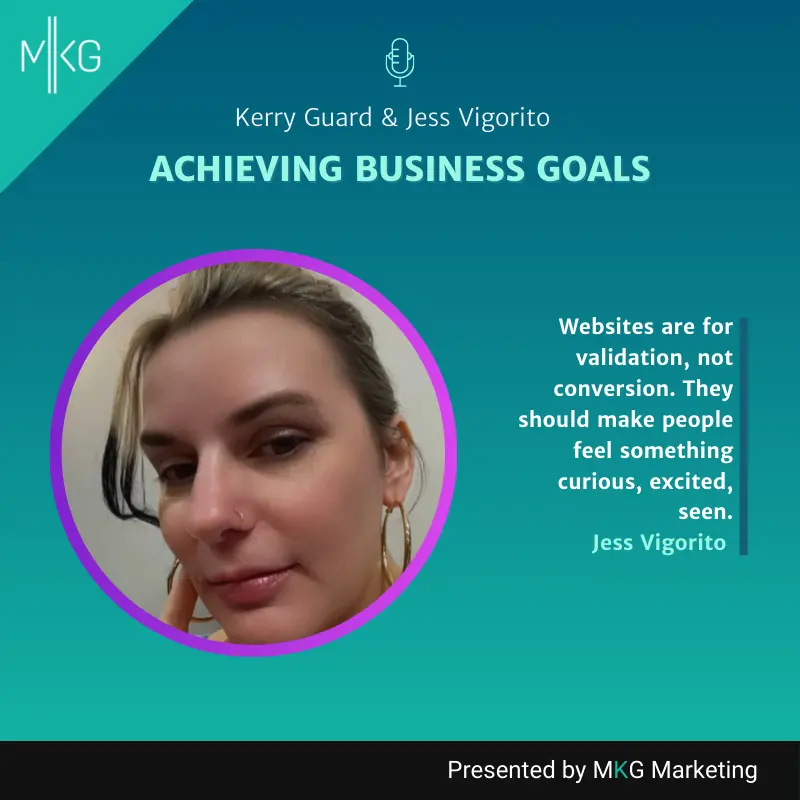
Jess Vigorito
Jess Vigorito is a creative marketing leader who builds brands, drives demand, and turns bold ideas into business impact.
Overview:
In this episode of Back on T-R-A-C-K, Jess Vigorito breaks down how early-stage startups can sidestep wasteful marketing spend by starting with sales. From building messaging with 40-word emails to syncing seamlessly with sales teams, Jess explains how real alignment (not automation) drives pipeline. She and Kerry talk AI, cold outreach that actually works, the power of founder stories, and why the first 90 days of a marketing hire are about trust and storytelling—not immediate ROI.
Jess also shares her take on modern websites (spoiler: they’re for validation, not conversion), building authenticity at scale, and how to translate sales objections into high-converting marketing content.
Transcript:
Kerry Guard 0:00
So tell me what is this magical email formula of 40 words. Are using AI to help you? Are you? Are you developing a brand personality? Tell me more.
Jess Vigorito 0:12
So first of all, my degree is in English and creative writing, so that's a very natural fit for me. I don't really use AI for these short emails. This is basically me sitting at my desk, and just I might use it occasionally, more like as a thesaurus. If something's not sounding right in the flow, I'm like, Okay, how can I word this? I'm missing something here. Not that I wouldn't come up with it on my own, but it just saves me a couple of minutes, but that's about the extent of what I would use AI for email outreach.
Kerry Guard 0:56
Welcome back to Back on Track, our second episode of 2026 founders, I hear you. The economy is weird. Cash flow is tight, and the instinct to cut costs is real. Usually, the first thing on the chopping block is marketing. But my guest today says that is the single biggest mistake you can make while your competitors are retreating. She's a fractional marketing leader who specializes in building the engine from the ground up, starting not with ads, but with the sales team. Jess Vigorito is here to help us get our positioning back on track. Jess, welcome to the show.
Jess Vigorito 1:32
Thanks so much for having me today. Kerry, I'm happy to be here and really excited to dive into these topics.
Kerry Guard 1:39
So many. I have a list.
Jess Vigorito 1:43
And there will be more as we digress.
Kerry Guard 1:47
Oh yeah, I love a good tangent. I'm here for that. Speaking of tangents, we're going to go on one right now because we just had a amazing conversation off camera, which never fails, because I wasn't recording, but I want to have it once again, because it's not something people really talk about, and it's happening all over the place, and you don't find many organizations who support it. So Jess, congrats on the new gig. You have a full-time position, and you started in December. That's so exciting, but you're still consulting at the same time.
Jess Vigorito 2:18
I am. I know, right?
Kerry Guard 2:22
I know not many organizations really allow or at least they didn't used to. Maybe they're being more open now. I know that we are, but if you have a side hustle, usually keep that on the down low, hush hush, because you don't want anybody to find out you need that side money, but you don't want the organization to get upset and think you're like, two timing them. So tell us, how are you able to do both?
Jess Vigorito 2:44
So I think it's a matter of time blocking and time management. So simply, you know, I have my committed time for my full-time job, and I work those hours, and I'm the director. I'm available after hours if anything comes up, as always. When you're upper-level management, you have to have that level of availability. But outside of those hours, Monday through Friday, nine to five-ish, I will consult with other companies and people and do side work. And you know, I have the whole weekend. I have evenings, and, like it's really important nowadays, marketing is no longer a static field. There are we are. We are evolving faster than we can even keep up with, so a lot of it is using AI to help us optimize our output and simplify our workflows, and that is one way that you can accomplish a great deal of work and content, and just project management, and it takes a fraction of the time that it has taken in the past. So, you know, I think Bernie Sanders is pushing for a four-day work week right now at 32 hours, and I think it's called the Labor Reduction Act, or something like that, which I fully support. I have worked a 32-hour, four-day work week in the past as my full-time job. And the level of work-life balance and just satisfaction I had, and the energy that I had when I showed up on Mondays was, I can't even compare it like it was unbelievable. And I would, I would very much so argue that my productivity on that schedule was every bit, if not better than it is on a five-day schedule, just because I had. We all know when we have those three-day weekends, like when we show back up, we feel recharged, we're ready to go two days, especially if you have kids, you've got errands to run, laundry like it never feels like it's enough. And so that third day is really beneficial. His whole point of this is that with. AI, their AI is doing so much of our work for us that we don't need to work 40 hours a week anymore, and that's outdated, and I can't even remember. I think it was the 1950s under Henry Ford when the 40-hour work week was created. Well, you know, 75 years later, we can modernize that. Now we have tools that help us do our jobs in a very, very efficient way. So that's yet another tangent, but, yeah, that's using AI to help us manage our time and really be productive. And that doesn't take away the creative component of marketing, and it doesn't take away the whole thought process and building it out, but it does help us simplify our workflows, and it can help us brainstorm. And, you know, we can program these llms in different ways and using different prompts in order for them to be, you know, contradictory to us, to kind of play the devil's advocate, or to just really be our ally. And it all depends what prompt you use and how, what type of response you want. If you're going to have a really tough discussion with your boss, that's something you can put right into an LLM and say, This is the project that I need to present. I want you to be antagonistic towards me like I want you to challenge me so that I can come up with really good answers and make sure that this is a very, very flushed out process, and now you're using it as a tool that's helping you, as opposed to you sitting here all afternoon going, Okay, now what are some of the questions that my my boss might ask me, or my client might ask me about this. It's doing it for you.
Kerry Guard 6:46
Yeah, it's definitely for me, particularly sped up the process, especially from a fractional marketing consultancy perspective, from positioning and messaging to understanding competitors to really getting the lay land so much quicker to be able to make much more thoughtful decisions. Also, from a productivity standpoint, I find that when I'm a little bit more backed up against the wall, my productivity shoots up versus feeling like I have all the time in the world. So I could see the value of a four-day work week at Adam kg, we split out between billable non billable time, making sure that people have space to do critical thinking around their job versus by client, and they can use that time called autonomy time. They can use that time however they want. So if they only want to be billable and work four days a week, they certainly can do that. But if they want to use that time to upscale and to find an opportunity to get better at their jobs, then they have that space to do it. So we do that here, and I, while it's not technically a four-day work week, Monday through Thursday. It's the same time billable time, so it's similar. But I agree, when you have that shorter time, you're way more you're way more productive in AI, certainly, absolutely helps with that. Let's talk about our some of our core topics today. When you join a startup, which you just did again, thank you, the founder is panicked. We've all felt this. They want leads. Yesterday, you've told me your first step isn't to launch ads, but to talk to sales. What are the first three questions you ask a sales rep to figure out if the marketing is actually broken?
Jess Vigorito 8:27
I'd say right off the top, I want to know their process. I want to know what the inbound looks like, and I want to know what the outbound looks like. So that's the very first question: can you show me the process? And a lot of times. The number of demos that are presented to you is a little different. Once you get in there and start talking to sales, you know, they might say, oh, yeah, we're booking 10 a week. And then you get in there, and you're like, Oh, so that's your pipe dream. We're actually booking on average, three a week. So it's really getting into the nitty gritty and understanding what the current process is, and seeing what where the loopholes are, where is there, where is there a lack of a feedback loop, and where do we need to cover the gaps? The second thing is, what is working? So when you're on these demos, what? What are the positive things that you're hearing from these prospects? Are they saying, Oh yeah, we heard about you, or we refer to you, we love you on social media? What are the positive things that you hear over and over again? Because those we want to capitalize on 100%, and the third thing is, what do you hear all the time that is a pain point, that there's a lack of education, or that people have a concern over and over again, and they're just not seeing it being addressed. So whenever I develop a marketing campaign, my. The primary goal is always education, first and foremost. Like, give people value. Give them a reason to pay attention to you. Don't just contribute to the noise that's out there, but give them something. And I truly believe, whether it's in your personal life or your professional life, when you give, it all comes back to you tenfold. And so marketing, I fully embrace that philosophy. Let's give to people, but let's find out what they need and what they want to be given. Before you know, we're not operating in a silo here. So what I think you might want to know may not be the case at all. So having that level of communication with sales is of the utmost importance. Sales and marketing. Everybody knows these are your two revenue engines. So the organizations that keep them siloed, I, for the life of me, I'm like, You're you're leaving money on the table over every single day, over and over again, let them talk and work together and collaborate on projects. That's how you optimize your output, that you get more ROI here. So that's very deeply ingrained in me, and that I maybe that comes because I have worked in sales before, and I understand both sides of it. My My first job actually was in sales, and a couple times throughout my career journey, I've insisted on starting in sales for a few months before transferring over to marketing, because I've wanted to really get a feel for what the sales process is like at that company, and what the challenges are and how marketing can work in collaboration with sales. So that alignment, that's 100% priority to me, and at my current position. You know, when I was interviewing there, that's when I met with the sales team, and that was a huge deal to me, that as a marketer, one of my interviews was with sales. If that wouldn't have happened, I probably would have been like, let me ask a couple of questions here to find out what your perspective is on sales and marketing. But if that's not acceptable, not only acceptable. But if that's not an expectation from the administration in the C suite, then that's probably not the right company for me to work with.
Kerry Guard 12:29
I work with a company and, as a marketing leader, and I loved that they brought their sales guy to all of our initial meetings. I just thought that was, and the very first thing I said to him is, I'm here to work for you, like I need to know what you need to make your job easier. And so right off the bat, we just hit the ground running. And I think that is really the so key to the success that we've had so far. I couldn't agree more. You mentioned that sales and marketing are the only two revenue engines, yet they are, and we just mentioned that they're constantly siloed. When you set up that feedback loop, how often are you meeting, and what specific data or feedback are you asking sales to bring to that meeting?
Jess Vigorito 13:16
So, in I mean, obviously I have a new position right now, but currently And historically, depending on the size of the company, it's been anywhere from one hour per week to one hour every other week. And so currently, it's one hour twice a month, every other week, and we had our first meeting last week, an official meeting between sales and marketing. And you know, the things that I'm asking them to bring are, give me the list that you're currently working on, like, where is your prospect list? Let me see it, and then let me go on LinkedIn and let me connect with these people. Let me invite them to follow our company on LinkedIn, so that when you, as the sales leader, reach out to them, even if they're denying the invite, they've already seen the name, and the curiosity is already there. It's already we're warming it up already for them. So that's step one in making their job easier. And the second piece of information I asked for was to give me the list of people whom you have worked with, who did not ultimately book a demo or buy our product, or, you know, you haven't really successfully reached them. You've tried, but and so the next level for us that we're working on together with sales is building that nurture campaign together, where we can send emails of high value, but also short and sweet. I'm a big believer in kill the scroll. The minute someone has to scroll, you lost them. So whatever you. Say it short, quick, and succinct, and make it engaging for them. So that's not as easy as it sounds to come up with an email or a message that's like 40 words long. You have to make every single word, every character count. And so there's a lot of intention there, but I have had a lot of success historically with my emails when I worked in sales. And actually, I just posted about this the other day, that a few years ago, I was working for a company as a as a senior SDR, and that was the company I was like, let me work as an SDR first, and then transfer over to marketing. So while I was working for as a senior SDR, I was writing these emails and reaching out to prospects. And I had, I had a whole document full of messages where people would reply to me, going, this is the most creative email I've ever seen. You made me laugh. This is amazing. And even if they weren't booking demos, we were getting that momentum. We were getting our name in front of people. So a recruiter had reached out to me via DM, and they were interested in seeing if I wanted to come and interview with their company, and I said, Thank you so much. I really appreciate it, but I'm really happy where I'm at. I'm not really looking to jump ship anywhere. And a week or two later, I had a demo booked with me, and I did not, at the time, make the connection that it was the same company. And so, you know, this is the demo that pushed me over the top for the month I hit quota. I was super excited. I jump into this call. And, you know, I start with the like, the small talk, the blurb, we're getting to know each other, high blah, blah, blah and, and he's like, Well, I just want to let you know I'm not really interested in your product, and I don't want to demo right now. And I was, why are we here? I don't understand. And he said, you know, your emails are so good, and we have circulated them throughout the whole company. I'm trying to hire you simultaneously, like, appalled at the audacity of this band to like, book a meeting with me, but also like cats off to you for creativity, dude, like that was pretty amazing, because I had already turned the recruiter down, and he wanted to shoot his shot. So even though it's years later, I still think about that and that that didn't work for me in that situation, because I really was at a position where I loved the company, but if I hadn't been there, that would have worked. And thinking outside of the box and being different from everybody else is so important, like, we just have to find our lane, and it's you can't, you know, I've had bosses before, and I've worked with clients before that are so scared to rock the boat and they don't want to have an individual voice at all. And I've even had a boss before who was like, 'delete that off LinkedIn.' We don't like what you posted, and at the time, unfortunately, I did, which is part of the reason why I insist on having my own fractional work too, because I never want to be in that position again. But that's what builds your brand. People always, ultimately, we buy from people. We want to know who you are. We want to know what you stand for, and if you're just doing the normal, you're not working on community, you're not doing any outreach, you're not valuing your customers, and you're not differentiating yourself. I'm not saying you won't be successful. You may still be successful, but at a fraction of what you would be if you really showed up as your authentic self, whether that's as a company, a brand, you know, as a human being, and you know, Starbucks is blowing up right now because they've had this, like, return to Office mandate. And there's all this. There's this. The CEO works from home, but the CEO is mandating like all these people have to return to the office, and if they don't, then they're not eligible for promotions. And it's a really ugly situation, and a lot of the employees are pushing back, because that has not traditionally been the culture within Starbucks. It has been very partner-led, and it has been they were the very first company in the United States to offer insurance for domestic partners. And so it's been very progressive. And so the people who work there are used to that type of culture, and this feels very wrong to them, and I don't know what to. Are behind their decisions, or anything like that. But it's really important to have that alignment ,looking from the outside as a consumer. I go, this doesn't match, this doesn't match the brand that you have worked so hard to build. And so companies need to build that brand. They need to take a line, and then they need to be consistent with it. Otherwise, it leaves not only your employees, but also the consumer is going, this isn't adding up.
Kerry Guard 20:29
Yeah, no. I mean, don't let me, I could easily get on my soapbox about we've been remote since before, way before covid And we've I mean, I live in the UK, my entire teams in the US, we're across five time zones. I don't understand how we're going backwards to mandating people to have to go back to work. Now, I think there's benefits to certain people being in an office, especially younger folks who need community, especially as people move around, I think there's definitely value there, but it's got to be up to the individual to decide that that's something that they need, whereas as parents, working from home is tremendously valuable in terms of the time that we save to be able to get work done while serving our families. So pros and cons on both sides, but a mandate I could go on and on about, yeah, I want to get back to your emails, because I think we're all on the struggle, boss, and when it comes to sending very short and sweet emails, I actually just signed up with a creative firm. Hats off to DesignGuru. Love working with them, and they caught me through cold email outreach, which is the bane of my existence. I have been on a high horse for a very long time about how this does not work, and people need to knock it off. But I don't know what magic they're using, whether it's instantly with clay or I have no idea, but somehow they realized I needed a creative shop, and they showed up in my inbox at the exact right time with a one line message, first email, I ignored second email, Caden and same again, one line and I was like, okay, booked a demo with them, saw what they got going on. I'm like, I'm in. So tell me: what is this magical 40-word email formula? Are using AI to help you? Are you? Are you developing a brand personality? Tell me more.
Jess Vigorito 22:24
So first of all, my degree is in English and creative writing, so that's a very natural fit for me. I don't really use AI for these short emails. This is basically me sitting at my desk, and just I might use it occasionally, more like as a thesaurus. If something's not sounding right in the flow, I'm like, Okay, how can I word this? I'm missing something here. Not that I wouldn't come up with it on my own, but it just saves me a couple of minutes. But that's about the extent of what I would use AI for email outreach, and I think part of the reason is as the your email inbox, as the algorithms on socials, as humans, we are all getting smarter. And our bullshit detector and our AI detector are getting really, really good. So there's, you know, I know, when AI first launched, it was like, oh, being a writer like that's that's going extinct. No, it's not like AI cannot mimic real human emotion. It cannot mimic our passion. It cannot write, with the at least not yet. It cannot write with that authentic voice. At the moment, these emails have to be so like number one, as I said, the scroll kills it immediately. And I'm sure, as a fractional marketing leader, because I know in my inbox on LinkedIn, it's insane, the length of messages that people will DM me after they connect. And I'm like, I don't know. Do you think I have 20 hours? I have nothing to do besides read your message that's this long, like it's an immediate leave me alone. It's like my reaction. And keep in mind, like I've worked in sales, I've done outreach, and you're irritating the shit out of me with this stuff. So I'm like, if you're irritating me. Then, can you imagine someone who is outside of sales, like you're just doing it? This is just wrong. It's not landing, so timing is always everything. With any level of outreach, timing is everything, but you don't know the timing. You don't necessarily know. Oh, this person is looking for the product that I'm selling right now? Sure. So keeping them, keeping your product, your brand, yourself, top of mind, is so important. Because, like you said, there's going to be that moment where you're like, I need this and, oh my gosh, it's in my inbox right there. There. This, and it feels like kismet, right? That's what you want. So, you know, it's very intentional, and I tend to rely on although, like my immediate circle, my kids, they'll tell you that I'm a funny person, but like outside of my family, no one ever thinks I'm funny, and I don't even consider myself to be a very funny person, like I have a very odd sense of humor. But in emails, that's one thing that I try to tap into. I try to put myself in the position, and I've been in the position of someone who's just drowning in an inbox. You're just constantly getting emails, and it's like, delete, delete. I have to read this blog and something to break through that, something to make a person smile, or something to make them pause for a moment and go, oh yeah. That was really, you know, cool. The best performing email I ever, ever created had a subject line, which I always try to keep to two to three words. This one was four words. So it was, it was red or blue pill, and it was right around the time the Matrix was coming out, and it was all the hype, and you so the open rate on that was through the roof. Like, people were like, What is this email about? And then he opened it, and it was just, you know, most people are looking at SDRs and hiring their SDRs this way. But if you want to be a little different, take this pill and call me, you know. And so it was short and sweet. People loved it. The feedback on that was fantastic. And that's the thing. I try to find either current events, current movies, current music, like something that's going to trigger something to break through that noise, or I kind of go back in time. So, who is your ICP? Is it Gen X? Is it a millennial? What's relevant to them? What's going to make them stop their scroll through their inbox and go, let me check that out. So it's also just, you know, acknowledging that we all have we're different generations, really examining who your ICP is, what age group that is, where do they live while they're working, but also outside of work. And you know, these very stuffy corporate emails. I get them all the time, as you know, professionally, but also personally. My inbox is full of companies who are marketing to me all the time, and sometimes I open up my inbox, and I'm like, gosh, you guys are just doing it so wrong. Like, I would never do this. You need to hire me.
Kerry Guard 27:47
Let me fix this for you.
Jess Vigorito 27:50
Yeah, kind of go through x Rio with my red marker. No, no, no. So that's, that's the key for me, is to just really sit in the position of where most professionals are, and we are just inundated with text messages and emails, and how do you break through that?
Kerry Guard 28:15
How do you cut through the noise? It's so hard. It's so noisy right now, and AI is definitely making it harder and easier at the same time, because you can identify the AI slap pretty quickly and move on, and then the things that aren't AI slap catch your attention pretty fast. So I think there is value to taking a step back and really doing it by hand in that regard, and using AI to support you, but not do the work for you, for sure.
Jess Vigorito 28:42
Yeah, if AI does the work for you, then you are just part of the noise.
Kerry Guard 28:47
Yeah, you're making more noise. Please stop making noise. I had this conversation with my team or developed a content system for our own marketing, because, you know, marketing yourself as a company is so hard when you're in the land of agencies, and I said, the most important thing in doing this is to ensure that we are not adding noise. We are constantly bringing value to our ideal customer, who's trying to figure this stuff out, and we're trying to help them not go at it alone. And I just I said, I'm going to be annoying. You're all going to be like, "I know you all bet," but I'm going to be annoying about it, because we cannot, cannot add to the noise. So I totally agree. You talk about objections a lot. How do you take a specific objection from a sales rep here, like it's too expensive, and mechanically translate that back into a piece of marketing messaging?
Jess Vigorito 29:45
So I think most companies hear that as a very common objection: it's too expensive. We can't afford it right now. That may be true, but so much of it is how. Do you present it, and so are you saying, like, oh, the annual plan is $5,000 a year. The immediate response from 90% of people, we can't afford that. That's too expensive. Okay, break it down to a month. Okay. Break it down to a day. Break it down to whatever your product is per message. Can you afford the point? Two cents per message, you know, like to reach your consumer? Well, yeah, I can, you know, to engage with your prospects. I can afford point two cents. Okay, let's do it, you know. So it's, it is, I mean, that's our job. Is marketing. A huge level of marketing is Psychology. We all know, like, you know, you're much more likely to buy something if it's one for 50, but it's two for 70 or two for 80. Well, you know, those two first get us all the time. We're much more likely so those, it's psychology. We all know 99 cents is more likely to get us to buy them $1 even though it's literally a matter of a cent. And you know, our gas, gasoline. I don't know if it's like this in the UK, but here, you know, we're still doing nine tenths of a penny. So you know, gas is $2.78 and nine tenths. And we'll go to that gas station because that one's 278 and nine tenths, and this one's 279, so the reality is, the psychology works. Marketing is grounded in psychology. So figure out how to make it more appealing to the consumer, to your prospects, and whether that's by, you know, really pushing the value in terms of what the dollar amount is, but also you want to position it in a place of, if possible, you can't afford to do this, because the payoff. So now we're going to talk about that ROI. We have to present that value to our customers, we have to show them this is worth investing in, and we do that through case studies, and we do that through testimonials, and we do that through math, and just putting it out there and making it idiot proof like.
Kerry Guard 32:19
You can't lie.
Jess Vigorito 32:20
Exactly, you know, statistics don't lie either. So it's, um, you know, they don't always tell the whole truth, though. So that's the thing to keep in mind.
Kerry Guard 32:32
So yeah, that's a whole can of worms in terms of which data, yeah, the vanity metrics of hiding the right data. For another time, I want to keep moving. You have a lot of hot takes on your website, where you believe websites are for validation, not conversion. If a founder comes to you and says, We need a new website to get more leads, how do you pivot that conversation to focus on messaging instead?
Jess Vigorito 33:02
So websites are absolutely essential to have, like, that's it's like, you're, you need a phone number, you know, you have to have a website. But as a conversion tool, depending on the product, it can be, it can be super helpful for you, but it also can just be more of like we just need to see that you're real. We need to see that you exist. So it depends on the product, and it definitely depends on the goal. We need to examine sales. What are the conversion rates? What are the landing pages? How often are we getting people actually coming to the website? How long are they staying on the website? What pages are they looking at? We do that both from looking at data and different metrics, but we also talk to the customer and find out what's working and what isn't. And overall, I see time and time again, these are like templated websites. They just don't communicate they, they don't communicate any real value because they're templated. They look like everything else, and in marketing across the board, like whenever. And I'm not a graphic designer, but you know, as marketers, we all wear a gazillion hats. I've taken a few graphic design classes in college, but it's not a minor, it's not a major. But yet, I know how to create graphics that communicate feeling. So if a graphic, if I see a graphic for a webinar, and it's just, you know, the name of the webinar. It's a solid color, and it's the person's picture. I'm yawning like this is not engaging me at all. If your website is just content and it's, you know, it's so boring, what is really engaging? Is seeing generate emotion. So see people in action. And I'm not talking about like the shutter stock photos. Like, who are you? It's almost the same as social; it's a branch of social media, really. Like, let's show up as you are. Let's see who you are. So I feel a lot of websites are lacking that connection. We still, as humans, seek eye contact, even with so many of us behind screens all the time. And you know, when you're on camera, we need to make eye contact. If we're like, if I'm talking like this and I'm like, nobody's gonna pay attention to me. We seek that out. We're used to working behind screens. You still need eye contact when you're on a website. So websites that have no photos on them, that have no action, that have no emotion, that don't draw us in are an immediate you're losing money again, you're losing customers, you're losing engagement here. Let's make it so that people land on your website and they are drawn in. They feel something, they're curious, they're excited. I mean, my son is joining, hopefully he's at MEPS right now, the medical exam, but he's joining the Space Force. And I have to tell you, like the US military, all the different websites for the different branches are really interesting, but Space Force is freaking amazing. Like, I just like to sit on that website. I feel good on that website. I feel excited about that website. And it's really weird to say those things, that a website can make you feel things. But this is an example of a website that is done incredibly well, and it is. So after the call, go check out their website. You'll see that.
Kerry Guard 37:06
I'm totally, totally going to, we're all going to, and they're going to get a huge spike in traffic. I love that as an example, and I think that's so important to I work for a law firm. I talk about them a lot because they're like, it's just working with right now, so it's top of mind. But as a law firm, when you go to any law firm's website, it's a wallof awards and pictures of men in suits, right? And so I immediately wanted to break that mold of making it more making it more accessible to folks, because they're they help families like that's their whole motion is, it's about being there to help families do their estate planning during critical times. So important, so hard, and so it was really important to me to make it warm and inviting and human eye contact. It is stock imagery, but it's stock imagery of the people who were trying to help. So I totally agree, and I love that of how important it is beyond just messaging, but it's also thinking about the imagery of how you want to show up and connect with people.
Jess Vigorito 38:13
Yes, that goes back to these companies that are so scared to step a toe out of line, like law firms, is such an amazing example of that, because they are all the same. And, you know, you could go to 100 law websites, and they're all boring. They all are all heavy with text. They're all men in suits. And you know, then they might have blind Lady Justice up, and that's, that's what they have. So nothing differentiates. If I landed on a Law website that showed pictures of families really communicating and engaging with each other during these difficult moments, end of life, or, you know, a marriage, the birth of a baby, I would be like, Yeah, this is who I want to they get it. They understand. There's empathy there. There's, you know, so, yeah, way to go, Kerry, we're on the same team here.
Kerry Guard 39:08
Pat myself on the back for that one. Oh my gosh. Jess, I have so many questions. I'm trying to figure out which one to close out with, because clearly we could talk all day, and happy to keep the conversation going. If you loved this conversation. You want to hear more from Jess, just comment below, and we'll get her back on the show. But for closing out here, we talked in our prep call many moons ago. It feels like a lifetime ago, so let me jog your your memory. But we talked about founders operating from a place of fear, hiring a marketer, but then firing them at month three, because the ROI isn't instant. What does a day one to day 90 road map actually look like? And what should a founder expect to see delivered in those first three months?
Jess Vigorito 39:59
So the answer to this is twofold, for sure, and I feel like founders frequently do work from a place of fear, especially in startups. 90% of startups fail, and so founders are like, trying to take that baby step, like we want to grow. We want to become bigger than we are. Let me hire marketing, and then that ROI isn't there in 90 days. Oh, I either hired the wrong marketer, let me fire them, or marketing doesn't work. And that's these knee-jerk, fear-driven responses and reactions. And also, they're coming from a place of they simply don't understand the value of marketing and how it works, even though they've been exposed to it their whole lives, because we're surrounded by it, that doesn't mean that they have an inherent understanding of how it works, you know, like I still remember the jingle to Oscar Meyer, which was what 40 plus years ago, you know? Or how many licks does it take to get to the center of a Tutsi roll call? I love that. So the owl, yes. So you see, these are things that are so well ingrained in us that that's marketing that has carried forward for decades, that didn't happen over 90 days. That's happened time, over time, over time, lots and lots of touch points. You know, all of us kids watching Saturday morning cartoons. How many times did we see that? And it came into our brains as they were being developed, and that's why we immediately know, oh yeah, I know that commercial, right? We all have that familiarity. And in fact, I don't like Tootsie Rolls at all, but every time I see a Tootsie Roll, guess what comes into my head? And as a marketer, I'm like, stop it. Like, I don't want that, but it is successful marketing. So I like to kind of point that out to founders, that there is no magic pill of like 90 days that we turn your whole business around. But the truth is that it is a foundation that we build, and it is touch point after touch point, and with social media and with video and all these different channels. It's very, very multifaceted. Now, like back in the day, it was Saturday morning cartoons for the Tootsie Roll, but imagine if we were rolling that campaign out now.
Kerry Guard 42:31
Oh my gosh, like you have to be across so many channels?
Jess Vigorito 42:36
Yeah, yes, and it does. It does have to be, and that is the thing. It takes time to build that momentum up. It takes time to build that foundation and one of the things that happens is you can fire your marketer at 90 days or 60 days, or six months, or even a year, and go, it didn't work, but the work that that marketer did do is going to carry forward long after they've left.
Kerry Guard 43:04
You want to build on it
Jess Vigorito 43:07
So you as a CEO, as a founder, it's really important to trust like go through the hiring process, make sure you have flushed out what you want to accomplish with your brand, and then share that with Your marketer, make sure you have the right hire there and and that's one of the baselines for me, is I want to sit down. I want to learn your story before we do anything. I want to find out how did you got to be where you are right now. What motivated you? What are you passionate about? What drove you to do this? Because that story is the thing that we capitalize on. That's what we sell. And that passion and that energy, that zest, and the absolutely marketers just need to it's a process, and it depends where you're at in the company. Are you starting from zero? Do they have any marketing? Are you coming in with some already established, so that first 90 days can look very different depending on where the company currently is at, but it still isn't going to you're not going to get a huge ROI in 90 days. And anyone who believes that or says that, I just, you know, I can't say that it's a blanket statement 100% of the time. But proceed with caution, yeah, make sure that they have, you know, stats to back up if they're making those types of promises, especially if you're a one-woman or one-man team. Like, let's see that process before you invest in that.
Kerry Guard 44:45
Oh my gosh. Jess, seriously, I have, I have, I just want to keep going. I have so many more questions. We're going to end it there. Folks, I know I'm super sad, too, like I said, comment below if you'd like just to come back on the show, and we will make that happen if they want to continue the conversation. One on one Jess, and they want to find out more about potentially working with you. How, where do they find you?
Jess Vigorito 45:05
I live on LinkedIn, so I'm sure you know, after the call, we can drop my profile in right on the on the comments there, happy to, you know, engage and talk, and I have all sorts of stream of consciousness posts that I put out there. You know, I tried to stick to my three content pillars, but, you know, like this conversation, I digress.
Kerry Guard 45:29
We all love a good tangent. If you'd like to learn more about Jess and her pillars and what you know how she might be able to help your messaging, please, please reach out, and we will drop her link into the show notes below. Thank you for listening. This episode is brought to you by MKG Marketing. Make sure you tune in next week, I am sitting down officially with Kathy Johnson to talk about GTM strategy and how to scale your leadership using AI. You won't want to miss it.