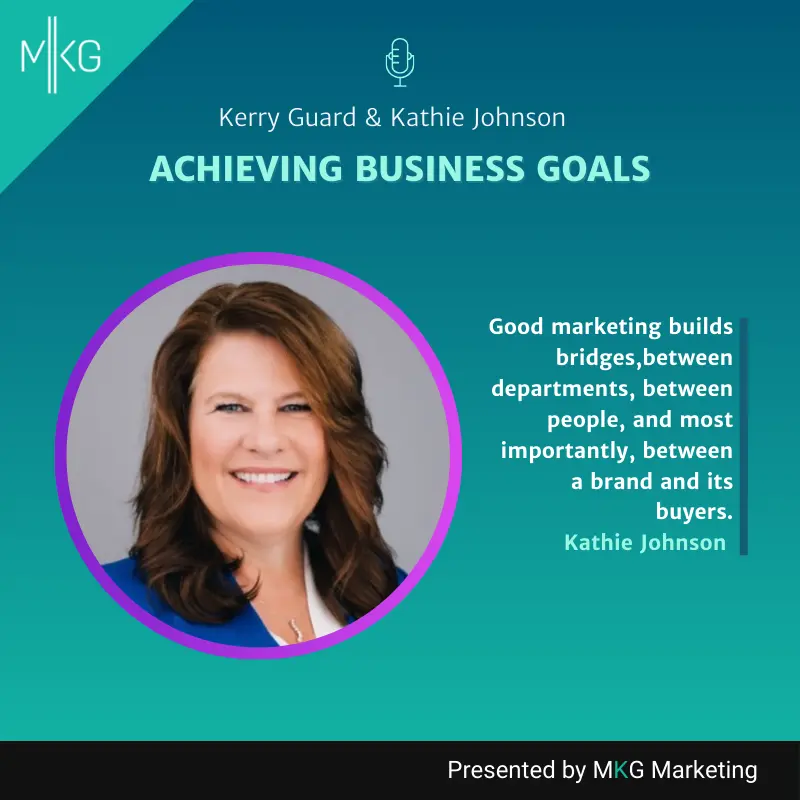
Kathie Johnson
Kathie Johnson is a seasoned B2B SaaS leader and fractional CMO who helps high-growth companies scale smarter through sharp strategy and GTM execution.
Overview:
In this episode of Back on T-R-A-C-K, Kathie Johnson, a seasoned B2B marketing executive and fractional CMO, joins Kerry Guard to unpack what most growth-stage companies get wrong: skipping the fundamentals. Drawing from experience at Salesforce, Talkdesk, and early-stage companies, she explains why alignment across product, sales, and marketing is more important than flashy tactics. The conversation covers verticalization strategy, cross-functional collaboration, prioritization frameworks, and how to thoughtfully integrate AI into existing workflows—without creating more chaos. A must-listen for founders and marketers trying to build high-impact systems that last.
Transcript:
Kathie Johnson 0:00
It's such a hard conversation to get a founder to understand, sometimes you have to go slow to go fast, right? And yes, you may be moving fast in a direction you think you're going in, but if you've wasted all that time and money because you didn't just pause for a moment and get the foundation done, you're actually going to be further behind. It's going to take longer.
Kerry Guard 0:30
Hello and welcome back to the show. We're here with Back on Track. If you're a founder or marketing leader stuck in the growth valley where what used to work isn't working anymore, and you're tempted to throw money at the next shiny object. Stop and breathe, because today we are looking at the engine, not the paint job. I'm joined with Kathy Johnson, founder and CMO of Excel Growth Partners. Kathy has run marketing at the highest levels, Salesforce, talk, desk, default systems, and now she's brings that enterprise discipline to growth stage companies as a fractional CMO, oh man, I am need to, I myself need to slow down here, folks. I myself am going to take a breath. Cathy, welcome to the show.
Kathie Johnson 1:16
Thanks so much. Kerry, it's great to be here.
Kerry Guard 1:19
So excited to have you been sitting. I'm so grateful that we're able to reschedule and get you back on the show, as this is going to be such a wonderful conversation. As I don't talk to many fractional marketing leaders who get to sit at such high up, such big, high up companies. Usually, fractionals are coming in at more of that growth and startup stage. So you have such a great, different lens, and I'm so excited to bring that to the conversation. Let's start from the beginning of terms, of how we think about marketing and strategy. You see a lot of founders and CEOs rushing to do before they think. When you walk into a new engagement as a fractional cmo right now, you're an interim CMO, which I have so many questions about, but we'll stay on track for the moment. What is the specific document or definition that is usually missing or completely wrong, like, where do people generally start rushing to do things before actually stepping back and really thinking about where they should be?
Kathie Johnson 2:26
I think that's such a good question, and it varies very much by size and stage of a company. But if you're talking about a founder, right, a founder is very focused on the product piece of it, right? It's their baby that they've developed, and they're so excited by it that, you know, sometimes there's this enamored love feeling that, hey, if I just put it out there, everybody will want it, right? It's the best next slice of bread. So really, taking that step back and trying to figure out, like, how do you position this? How are you truly differentiated from other companies? How are you going to message it? What are you trying to accomplish? Where are you going? Who are you selling to? Like all of that foundational level. Often think about it like you wouldn't build a house by putting the second story on the first right. You build a house by building that foundation in the ground, getting it super solid. You may make iterations on it as you learn and go forward, but you have to start with the basics. What are you selling? Who are you selling to? What's your differentiation? And so Kerry, obviously, in the marketing language, it's how are you positioning yourself? How are you messaging yourself? Who are the personas you're targeting? Like, I think of that as the very foundation of everything we do in marketing, everything.
Kerry Guard 3:48
I actually just had a founder, totally dear, and headlights me like, literally tendency for this conversation, because I told him that exact thing. He's like, but I have to go. I have to I need leads. I'm like, you do, and you're doing all this content, you're you're doing all this activity, but is it amounting to anything? And he was like, Well, no. And I was like, Well, if you are tying that back to the core differentiator of why you and what problem you solve better than anybody else, then that activity will amount to something, yes. And he's like, yes, yeah. It's such a hard conversation.
Kathie Johnson 4:22
It's such a hard conversation for a founder to understand; sometimes you have to go slow to go fast, right? And yes, you may be moving fast in a direction you think you're going in, but if you've wasted all that time and money because you didn't just pause for a moment and get the foundation done, you're actually going to be further behind. It's going to take longer.
Kerry Guard 4:43
Absolutely, that's for founders and smaller companies. What about for more of the more established brands when you come in as a either a fractional or interim? Cmo, what sort of rushes mistakes are you seeing from that? Side of the house?
Kathie Johnson 5:01
I'm not going to go into rushes or mistakes, but I'll go into what do I really look for. And I really look for a marrying or mapping of what is the company strategy is, right? And it does also goes to, you know, do we have the right ICP? Do we have the right persona? But then I do a tremendous deep dive into the data right to really look at, is our pipeline closing one, are we at least at benchmarks or higher, right? So looking, trying to figure out, Okay, once I understand fundamentally who we are, where we're going, and is that ICP is right to incorrect. Then, looking at our motions Right, right, dependent upon the type of company we are, have we established the right marketing motions to be successful in the space that we're in?
Kerry Guard 5:53
I love that. It goes into the GTM strategy, right, if a company is trying to move up market? This is a different kind of question. But yes, in terms of that, that GTM strategy, starting with that data, I love that if a company is trying to move up market. So we're talking about that sort of like either going from, you know, smaller into that scale up, or scale up into that enterprise. That's a totally different, you know, everything sort of has, you sort of have to rebuild almost. How does the ideal customer profile actually change, not just bigger companies, but specifically, how do the firm go graphics and psychographics shift on paper when you're trying to move up market?
Kathie Johnson 6:39
Well, I think one of the most important things. And Forrester and Gartner will have this in their data, but all of a sudden, you are looking at the buying committee being completely different. Like this. Mid-market might have one to six right contacts that are within the buying cycle. And once you get into enterprise, you know, I think the latest data says like 12 to 18 buyers in it. I mean, that's a completely different motion, because you're all of a sudden now triangulating, or whatever the word would be, for 12 different buyers around that account. So your marketing motion is to think about all of the people in that buying cycle, and not just the one to two to three that you might have in a much smaller company.
Kerry Guard 7:21
That I'm jumping in the weeds here for a second, guys, I promise I'll jump right back out. But I have to imagine in a world now where it where our resources are already being diluted, and we already have to be in so many places now that we have to talk to all of these people, how are we supposed to get all of that done with the resources we have at any stage? It never feels like enough.
Kathie Johnson 7:49
Kerry, have you ever met a marketer who felt that they had too much money, too many people, like never? So, regardless of the size of the stage, there's always the need to focus right, really honing into where do we have the right to win? Where are we having the most success, and focusing there and winning there, and then expanding? I think sometimes we expand as organizations too far, too quickly, and sometimes that can lead to, you know, a subtraction later. So, regardless, there is a need to focus. And then secondly, of course, in the world of today, it's how do you tap into the power of AI to augment your team so that you can not do more with less? Because I don't agree with that, but do the right things with the resources that you have.
Kerry Guard 8:44
You're big on verticalization. It's a horizontal SaaS company that decides to verticalize. What are the first three data points they need to look at to pick the right winner?
Kathie Johnson 8:57
That's great. Let me tell you, sort of the approach I take with verticalization first, and then I'll answer that specific question. I really think verticalization has three stages, and the first stage is just about speak the language. That's the easiest piece. That's where marketing may play the role. That's where you're just using the language that speaks to that audience. Think of customer versus client versus patient, and that's the very basic level. Then the second level is, how do you build or package those solutions and use cases? This doesn't involve engineering, but it does involve marketing and sales, working on what are the most important use cases that you can solve with the technology you have today, by packaging the different features, functions, and products that you have in your toolkit already. And then the third is building a verticalized product, right? And that's where you're actually making that investment, from an engineering and product perspective, to solve those most important use cases that you've discovered. And when you think about it, if you fall. Of that process, you learn all along the way. So you learn by speaking the language. Was just the least expensive way to invest in verticalization and see where you're getting traction with the solutions you have, and can fine-tune it. And then secondly, you can start looking at the solutions, learning from that, and then build the product. But then specifically, like, one of the things I do when I first go into the company is I'll look at what I call these bubble charts, and I'm looking across all of the pipeline in the company that has come in in the last x time period. And I'm looking at what the average selling price, what the velocity of that pipeline, and what our closed one ratio, and then looking along those bubble charts by region, in that upper quadrant is like highest velocity, highest deal size, highest win rate. And that's where we should go start. And so that's the first ones I look at when I'm really thinking about where to focus do.
Kerry Guard 11:03
You think that verticalization is key and that everybody should do it? I'm sure it depends. But I mean, we see so many companies verticalized, but then you go to their website, once they sort of hit enterprise, and they have like, 10 verticalizations, then have they really verticalized? So help me understand, like, when should a com what kind of company should verticalize? And are there any examples that don't make sense where they should definitely not go in this direction?
Kathie Johnson 11:35
Yeah, it's a really good question, and it's a fine line to pass, I think, for really small organizations, unless they're starting already with a vertical motion. Like a lot of the AI startups, other than the big LLMs, might have a vertical lens to start. Like one of the companies that I'm supporting as the founder, as an advisor for, is very focused on a particular vertical. That's great. You get traction. You're able to focus, I think, where it gets tough if, if small companies are trying to focus on three or four verticals overall, that you're just spreading yourself too thin. And I think whenever you start peanut buttering, then it's too soon. But I would always suggest starting with one when you're at the right size and scale, and you're starting to see traction in a particular area, like, if you do an evaluation and you see, hey, we're winning the most in this sub vertical within manufacturing, you might want to lean in a little bit more there and see if you can actually improve that Velocity, improve that win rate by being verticalized again, thinking of those three steps with language first. And if you're not seeing an improvement, then you probably can stay horizontal.
Kerry Guard 12:52
Once the strategy is set, whether it's going, you know, verticalization, or maybe your ICP just changed, and you know, you have a bigger audience that you need to talk to once, yet once the strategy said, we need to get ready. In your experience, where is the biggest disconnect between the product roadmap and the marketing message?
Kathie Johnson 13:14
That's a great question. I think I hate this response, but I think it varies by company, right? One of the things that I find sometimes is that marketing a product might not be really tightly aligned, and you're going to see a really big disconnect if they're not completely working together. So, thinking about the organization I'm in now, we're talking across product sales and marketing about having no light between us, like, how do we make sure that we are consistent in everything we do, because our teams feel that impact, our customers feel that impact. Our partners feel that impact when we're not, so I think you know to solve it. Let's make sure we're really closely aligned with product as well as sales, and do testing along the way. But it really varies every company you go into.
Kerry Guard 14:04
Yeah, I think what you're saying, though, which doesn't vary, which, I think we all are acknowledging that this is a problem, and now we need to, unfortunately, try and fix it. But there does seem to feel like a lot of fraction between departments, from sales and marketing to marketing and product to customer success. I even did a blog post or a LinkedIn post yesterday about even demand versus brand, right? There are all of these. We have segmented our organizations to an extent where Now none of them are actually working together and are aligned. How do you help close those gaps, bring that together so there is no light going between? Where do you where do you even begin? Because it feels so big now.
Kathie Johnson 14:54
It feels so big. It's such a good point. And you're right. It's that alignment, that title. Alignment, and it's not just aligning at the leadership level, is how do you then carry that forward? Because I've often heard that companies might go in and they say there's an alignment, but then you go down into the organization, and it's misaligned. You know, one of the things we're just working on, where I am today, between, again, product sales and myself, is we meet every week. We have a running list of topics that we're getting aligned on and then communicating to our teams. And I think it has to start there, right? And we have to show up as a united front. So we recently just communicated to the company, like across the three of us, we have one North Star, we have one prioritization. We have one team, right? Everything ladders up to those three things. And then I brought the head of product. I brought the head of our CRO to the marketing all-hands again to restructure or re-emphasize that importance. So I think it really starts with the behavior of the ELT. And it's not just acting it, it's actually living it as well.
Kerry Guard 16:05
That's one really lovely example of how you're living it, in terms of actually bringing one, having the meeting every week, and then, you know, having people show up to different meetings to re-emphasize. I think that's just communication. Communication always seems to be, "we're in communication." You think we'd be better at it?
Kathie Johnson 16:23
The cobbler's children never has shoes. Kerry, I always remind myself of that.
Kerry Guard 16:29
So true. You've worked at massive orgs like Salesforce. What is the one planning ritual or operational habit from the enterprise world that a Series B startup should adopt immediately, or at least work to?
Kathie Johnson 16:45
Well, I think that's a really good question. I think it comes down to prioritization. I mean, although I haven't brought this into every company I've gone to since, one of the things that Salesforce does tremendously well is the v2 mom, which is vision, values, method, obstacles and metrics, and aligns it all the way from Mark all the way down through the organization, so every single individual can see how they impact the business. So obviously, that's a much more robust thing than you might do at a series B, but I think the alignment piece is really important. So what is the core objective at the top, the alignment, and I would say the focus and prioritization, because everything we wrote in that v2 mom was in priority order. So if you knew it was number one, it was more important than number three. And I think regardless of size, what's so helpful for organizations is to understand, if I can only do one thing, what's that one thing, and going to that top of that prioritization list. So how do smaller series B companies, from the founder or CEO down, really make it clear to the organization, like, here's our number one priority, our number two priority, and our number three priority, and then stop at that. Right?
Kerry Guard 18:01
Yeah. I mean, just even trying to understand as a small company myself, who follows traction and has been trying to set goals for years and failing at it. It is, it is that it is hard to identify what is the priority and what is the goal is, and it takes a few years to like identify. It's the roadblock. What's the thing that's making our organization not move forward? And is in our way, we need to go solve that, effective immediately as a whole, from the CEO to what they do daily, to down to the assistant and the work that they show up and do, that's that's helping unblock that thing and move us forward. Totally Wii. Gig sounds so easy, but that is not easy.
Kathie Johnson 18:45
It's one of the hardest things. I mean what? There's the saying that if I had more time, I would have written a shorter letter. I forget who's quoted for that, but taking the time to really make it credibly easy to understand if the organization is important. And then Kerry. One other thing that I want to add to this. It's not only putting it on paper, but that it's putting it into your all hands all the time, going back to it and sharing where you've had successes, where you may need to tweak and similar to you, like I have a small organization as well, right that I founded, and when I wrote the business plan, and then when I did the marketing for it, before I actually put the marketing and market, I went back to the prioritization of my business, kind of like, am I matching what I said I would do? And I think that's true for all organizations. Once you've come up with that prioritization, making sure you're always going back to that North Star for your company is what you're doing, matching what you said you should do. And if not, then go tweak that North Star documentation before you go and mark it with something different.
Kerry Guard 19:50
Yeah, and it'll change, totally change. I mean, for us, it hasn't miraculously our, you know, 14 years ago when we started MPG marketing, the. The question was to be to make sure it was measurable media, and everything we were doing was mapping to its impact, whether it was leading indicators. You know, at first it was very lead capture, because that's where the market was at the time. How do we attribution wise? You know, the last touch to qualification, right? And now that's changed, and now we have to talk about leading indicators, but it still comes back to how are we measuring this, and what is the data telling us, and how are we moving forward with that? So for us, it hasn't changed, but it certainly could, and go making sure that your marketing messaging is mapping to that I love. I feel like I could even be doing that better. So thank you for the reminder so important to make sure those are aligned. Let's talk about execution. Everyone is obsessed with AI right now. You mentioned it early on, outside of just generating blog posts, please. People stop doing that. Where are you actually seeing AI? Speed up the GTM engine. Do you have specific workflows that you're using?
Kathie Johnson 21:05
Yesterday, I was on a call that Lisa Adams and Carlo Dietrich did for it's an AI cmo club and a gentleman. I wish I knew I was going to talk about this, because I'd go look up his name, because I was mind blown by what he presented. He really shared how he has stitched together different technologies, including things like qualified, but also clay and some workflow stuff, and he has actually built an entire system now that goes through many of the touch points in marketing, from when a lead comes in and is qualified. How do you then use an AI SDR to qualify it? And then, how do you create all the streams of content? How do you fill in all the gaps with clay in terms of who the contact is? And then, how do you do all the communications after, like, I was super impressed. If I could remember the gentleman's name right now, I would give him a shout-out.
Kerry Guard 22:04
He was him in the comments, for sure, once you once it comes back to you.
Kathie Johnson 22:08
Yeah, I walked out of there inspired. And also like, oh gosh, I thought I was, you know, pretty good at this, but now I feel really behind. But yes, I will share his name later. It was amazing.
Kerry Guard 22:22
Please do. I'm hearing this all over the shop, in terms of, you know, the ones who are ahead are definitely figuring out how to connect the systems. And I just it. That is the heart. It's like now, it's a relative, it's easier. I don't say it's easy, but it's easier now to build dashboards to connect up systems and to show the data and how it overlaps and what's feeding what, right? But there was a time not too long ago where that felt impossible, and I feel like we're kind of in that stage of, okay, we know how to generally use AI. We know how to speed up some of our work on a regular basis, doing your positioning and messaging and all that research, and feeding it as much information and all the data, and building all that definitely helps. But now we're in that realm of like, okay, like we were with dashboards many moons ago. How on earth do we connect this? So he's definitely like, out ahead. That is definitely what we're all aspiring to. But it is not, it is not easy. It's the systems don't quite the technology isn't quite there for it to just work. So hats off to him.
Kathie Johnson 23:28
It was very impressive. And I think that's where the game-changing opportunity is for people, is really connecting the different tools or systems, having that proper workflow, understanding your processes, like there's really magic in that, in the results that it can deliver.
Kerry Guard 23:49
How are you using it then? So that was one wonderful example of somebody else who's who's figuring that out. And it sounds like we need to catch up real quick when we're on it. Kathy, but in the meantime, how are you using it in your day-to-day to help with your workflows and help your team integrate it more often or not? I don't know what sort of your stance is, yeah.
Kathie Johnson 24:11
So at my prior organization, we had actually, you know, designed out and started building agents to support to work alongside marketers. So think about an organization that has X number of agents to every employee, and really picking those places where it can make a difference. And it's not just writing blogs to go back to how you started it at the organization. I met today, we have some work to do, but we will be working on that, what I call horizon three. So I'm excited for where we will go with it, but individuals within the marketing organization where I am are using AI for different things today, but they're not all connected, not yet, not yet, but they will be.
Kerry Guard 24:53
It'll be magical. I'm a really big fan. I've been really enjoying gem so I use Gemini. I've switched over. From ChatGPT for a whole host of reasons, but gems have been an absolute game changer in terms of like developing little agents to do specific things in relation to what I really love about it is that it's not just creating a brand marketer gem. It's like putting your spice on it in terms of how you think about brand and how you approach it and why, in your experience, and giving it all that sort of context of how you want to approach it is just so and that it works.
Kathie Johnson 25:37
It does totally. And one of the things, you know, as a fractional or interim CMO, I really do use my own Kathy Johnson AI as a thought partner all along the way, right? So, and then also build out, like interviewing for this role I'm in now as an interim, really built out some GPTs on the folks I was going to be interviewing with to see what questions they might ask me, right? So leveraging it that way, and then I'll tell you, I went to the AI conference, AI Institute's conference last fall, and one of the things that they shared, that which I haven't done yet, but which I loved, was building your own board of directors. So, picking the areas that you yourself are not as strong in, identifying the people in the world that you think are the best at that, building a GPT on those individuals, and using that as your own board of directors to challenge you on what you're doing. And I loved that idea. I haven't done it yet, but it's on my list to do.
Kerry Guard 26:43
Oh, I want to go do that too. That sounds awesome. I never thought about it that way. I even feel like I could do that for clients in terms of, like, who they aspire to. I work with some coaches, and I might, and they reference like, the Brené Brown of the world, and so exactly interesting to build. Like, how would Brene think about this? How would Adam think?
Kathie Johnson 27:07
Exactly, cool? Isn't that awesome? Yeah, that was a great idea that was shared.
Kerry Guard 27:14
Yeah, I have to say, I don't know. I love your take on this, and I think you said it earlier. I don't really think AI is speeding us up so much as making us better. And I think in some regards, it's slowing me down, because I just have all these questions, so I can't help myself but go down the rabbit hole and forget to pull like not pull myself out, and almost feel overwhelmed. I've had similar experiences.
Kathie Johnson 27:41
It's changing so quickly, right? You miss a day or two, and you feel like you're years behind. It's very different than it used to be from a technology shift perspective. So yes, I think that there's that piece. I do think there's efficiency for sure. I think there's some good thought-challenging that goes on as well, which is great. And then once you see what I saw yesterday, like stitching it all together like that's a complete game changer.
Kerry Guard 28:10
Yeah, there's a company called monks. They showed us a demo at the World World Forum, the martech World Forum, here in London in September of last year, and they did it with they created a puma ad, a full-blown commercial with agents. So the commercial itself is not AI. It's real photographs. It's a real video done by real courage, but it's agents that there was one agent that was responsible for making sure that everything was on brand. There was another agent that went out and talked to all of the creatives to get what they needed. There was a producer, agent that stitched it together, another agent that did customer surveys and fed it to customers, and got their feedback, like there was an agent for every single minutia job to be done, stitched together, talking to each other, and they created. It took them months to build, but the ad itself only took two weeks, a full-blown, like 32nd spot that you would put on proper television.
Kathie Johnson 29:14
That's amazing. That's amazing. Wow, I haven't seen that. That's very cool. I tell you, it just opened your mind to the possibilities.
Kerry Guard 29:23
It does so in terms of efficiencies. I think it could. It has the potential. It's taking the time to build it that's going to be fascinating to see how, how we all get there. When you launch a campaign in a new vertical, what does your minimum viable test look like? How much budget or time do you give it before you kill it or scale it? Wow?
Kathie Johnson 29:52
Such a good question. Time. Length of time, I think the key is at the beginning to try. Determining what's going to be your go, no-go, to go forward. And those metrics might vary depending upon what you're trying to accomplish. Right? Are you trying to do an expansion within a customer base? Are you trying to go into net new, for example? Are you going into a place where you don't have awareness today, or do you already have awareness? So I think identifying your go, no go, like starting it with that is really important, I think, also looking at the cycle that you have in your own company. So I often look at how long is that lead cycle is, how long that opportunity cycle is? And so what are the green shoots you're going to look for? Because, gosh, if it's enterprise, you're not going to know for 12 to 18 months. If it's mid-market, you might know in six months, but you have to look at those green shoots and then make tweaks.
Kerry Guard 30:48
Yeah, it's definitely like, I work for my company, my core company, primarily works in B to B Tech, with very long 18-month sales cycles. And I got the chance to work with a lawyer who does estate planning, and their sales cycle is six weeks. And it was just totally different then, right? Mind-boggling thing. I was like, I am getting data and testing back so quickly. This is amazing. Like it was a breath of fresh air, because it's true, you really do need to wait, like, put things out into the market and give it time to really marinate. And I think that's what it comes back to. We talked earlier about positioning and messaging. So, really taking the time. If you have long sales cycles, you cannot afford to put something on the market that's going to need six months to know whether it's resonating. You need to know going in that you're really feel like you're on to something, because you're not going to see it really resonate for a while.
Kathie Johnson 31:50
Which goes back to what you started talking about near the beginning, about the founder you were working with, right depending on how long that sales cycle was, if they just went in market now without taking that pause for that messaging and positioning, and let's say their lead cycle is only six months, which would be a gift outside of B to C, right, a gift they're not going to know for six months really.
Kerry Guard 32:11
His story is interesting because, and I know so many founders and CEOs, and founder-led, CEO led stuff is happening right now, for you folks, and not we're I'm feeling it too. I don't know if you are Kathy, but you know, LinkedIn was sort of like the wild wild west about a year and a half ago, where our impression numbers were off the charts, and people were seeing our stuff and engaging with it. And it feels like we got cut off at the knees a bit in terms of now it being so focused on comments and engagement, and not I'm lucky if I get a post to see 250 impressions, and I feel like that's a win these days. How are you are you seeing the same thing in terms of, like, the LinkedIn social media world, and how are you helping CEOs? And you know, even your own marketing initiatives sort of navigate the new world of these algorithms and how they're trying to really put, you know, put emphasis on the the need for value in the world, versus just an AI slot.
Kathie Johnson 33:15
Yeah, it's a really good question. I think one of the things that's super interesting is so many of the founders I work with because they are very product LED. Posting on LinkedIn is not necessarily what they wake up thinking about. So one of the first motions I always do is help them think about it, picking their three up to three threads of topics that would be important, that always lead back in some way, either directly or indirectly, to what they sell, and really staying true to a who they are, and also to their customers. Like, I think telling the stories of customers, telling the stories of real works occurrences, is better and and then also, I mean, similar to all of us, like, hey, when I launched my business, I did the old trick of reached out to, you know, friends and colleagues and said, I'm posting on this day. This is what I'm saying. Will you help me amplify it? And so I share that with founders too. Like, think about it's a program. It's not just you posting. So, for the really important ones, how are you thinking about tapping into your own network for help with amplification? And you know they say, has to happen within 10 minutes, ideally, which is so quick, so you need to schedule it ahead of time with people. I'm going to drop it at 705, on this day. Would you be so kind to go in and help me amplify it before 715 and be clear on time zone, because that happened to one instance where someone's like, I'm ready. Yeah, you're in a different time zone. But I mean, it's the little tricks. It's going back to some of the basics. Kerry can make a difference. Yes. And I think the other thing that's really important is thinking about those other avenues, thinking about the places where the LLMs are pulling from when you go back, not just to LinkedIn, but how are you helping to drive your brand within, within the LLMs, be it Reddit, be it YouTube, etc.
Kerry Guard 35:21
Yeah, I'm really digging the visibility score in SEMrush. That's been really helpful to know, like, how you're showing up and if you're showing up and at what scale you're showing up. As an SEO agency. Now, geo being like part of the core of what we offer. I still believe good SEO is good Geo, but there are specific techniques that you need to lean into from a geo perspective to help that get visible. And so, yeah, that's definitely been a very fun challenge in helping brands get seen, because it's now less about necessarily website traffic. Welcome to the zero-click world. More about visibility. It is old school. It is the view through right? Yep. As a fraction leader, you have to prove fast value. What are the specific metrics on your dashboard in the first 90 days that tell you to ship? The ship is turning around and don't say revenue. We know that's a lagging indicator.
Kathie Johnson 36:24
I was going to say revenue. One of the things really was at this company I'm at now, I started December 1, was very quickly coming in and doing a full assessment and being able to share back. This is what I learned from the data that we have, and this is where I think we need to shift because of it, and then getting that, you know, social, or doing that socialization across the leadership team, I think that helped me gain trust and confidence right at the very beginning, because we all know it right. It's so important that the marketer understand the audience, understand the business. We're not just marketers. Don't just do creative and making it very clear at the beginning that this is what I can offer, and then sharing those insights, and of course, listening, because you're new in the company, listening to what may resonate, what may not, and adjusting accordingly. But to me, that's the biggest way to gain confidence and trust at the beginning, is know the business, know the data, share the insights, and then also, equally importantly, share what shifts you think need to occur based on that data.
Kerry Guard 37:38
I think, yeah, I mean, taking a minute to just sit in it and wrap your arms around it is absolutely critical. And I love that you're talking about sharing the insights. I think sometimes that gets lost is that you find all these insights, and then instead of sharing what you found, you immediately start sharing solutions. Just go fix stuff. And so I love what you're saying, and I'm doubling down on it, because I tend to jump right to a solution. I kind of that's what I did today. It's poor guy deer in the headlights, versus towards taking that step back and sharing more of the insights of what I found that led me to get there, I think would have been much more helpful for that journey. So yes, yes to that. I think, you know, we all want to just jump in and start solving, and we want to show value immediately. But some slow is smooth, and smooth is fast, taking a minute to really understand the company, understand the people you're working with, what makes them feel successful, I think, is absolutely such an important first step for sure. How do you handle the feedback loop with sales? When sales says the leads are weak, what is the first thing you audit to verify if that's true?
Kathie Johnson 38:53
That's a really good question and a very common comment, right? Really digging into then how are I often look at, like the leads and how close they are to the ICP that we've identified as a company. So if it's between 65 and 85% because you're going to always have inbound that doesn't match, then it's probably okay. I like it closer to be 85 if it's way below, like 65, and yeah, they're probably right. So that's the first lens is really looking at, are we bringing in the leads in the ICPs that has been identified? So that's step one. And then step two is really digging into that whole lead cycle and process through opportunity, are things actually being followed up on or not? And then third, if you're lucky enough to work at a company that has a tool that allows you to listen into conversations, I think really going through or leveraging AI to bring that insight back on what was happening on those initial calls. Wasn't the wrong person, was the wrong ICP, etc.
Kerry Guard 40:05
So, taking ownership from a marketing perspective seems like step number one, generally, the if the leads are weak, figuring out why they're leak and why they're weak, and going back to your marketing team to say, Okay, how are we going to tighten this up? And then, and then working with the sales team to say, Okay, here's some opportunity on that side. So it sounds like you do a really good job of sort of balancing both falling on the sword and then talking about how we work together. Is that today?
Kathie Johnson 40:33
I think my core is to first go to data, right? Yeah, go look at and see if the data actually tells us the same story or not, right? And also, is it consistent across all the regions or not? But then, yes, there's shared responsibility everywhere. What can we in marketing? Do better? What can we in sales? Do better? I really try to avoid it so hard, but I try to avoid that finger-pointing that so often occurs, like, this is our problem. This is our money, this is our time, our effort. We've aligned on this together. What do we need to do to fix it? And then, you know, I'm very I'm biased for action, for sure. And so then, getting to what are we going to do about it?
Kerry Guard 41:18
So bad, I'm terrible. I totally jump into action. Have you ever run into a scenario where it actually wasn't marketing's fault? How did and how did you handle that?
Kathie Johnson 41:31
I absolutely run into that, and that's where the relationship with the CRO is so important. Because if you have built that trusted relationship, then you can pull that person aside and say, Hey, I need your help. This is what I'm seeing. Here's the data, which even data can be refuted, right? So hopefully you've built at the very beginning. I always like to make sure we have signed contracts on leads, definitions, SLAs, all of that, because then you don't end up in that debate at the time when you need to solve a situation, because you've already agreed on that you've signed on that document together. So then you can really focus on based on everything we stated in our document. Here's the data as we're seeing it. I need your help.
Kerry Guard 42:23
Yeah, starting at the top, as you said earlier, so important, that's why. And then it comes in handy. Last question, I could talk to you all day, Kathy. This has been wonderful, but last question for you, scaling creates chaos. We've all been there. When a team starts growing fast. What is the first process that breaks, and how do you fix it before it cripples the marketing engine?
Kathie Johnson 42:48
Yeah, that's such a good question. I think the first thing that breaks is the whole process breaks right? Because all of a sudden, people are saying this organization's not moving fast enough for me, so I just did it myself, right? That's where the breakage really happens. So even with the organization I'm with now, we actually have a whole planning session, starting, kicking off today, really looking through all the processes, what are the daisies? And going back to the basics, I think what's so important is when, because people generally have really good intentions, like they're breaking the process, because they feel they have to to make their numbers their targets, to do the right thing for the company. So, going back to why it's breaking? And do we want to all collectively make a shift? Do we need more creative? Do we need more in content? Where would we reduce in order to do that, and making it a shared problem to solve is really important.
Kerry Guard 43:49
I love, but like going to figure out why the system is breaking terms of people taking, like, not following the process anymore, because it no longer serves them, and then sort of being able to quote, unquote, plug those holes, but in a meaningful way that then sets it up to scale over time, versus, you know, just putting a hand here and then here at the foot.
Kathie Johnson 44:10
I know a couple of band aids, yeah.
Kerry Guard 44:15
Yeah, when we're biased to action, that's what happens, right? But when you take the time, like you're talking about, of really understanding why people are sort of taking that ownership and not following the process. I just that's such a great way to approach it.
Kathie Johnson 44:30
And your language is really good. I wish I had said that. You're right. It's when the process no longer serves them, I think, because, again, it's all with good intentions.
Kerry Guard 44:38
Absolutely, absolutely, as you said, people are just trying to hit their numbers. So it's definitely like, what do i This isn't working. I totally did this to my team yesterday. I broke the process. I did not follow the process. And they were like, Hey, you're making promises that we it's not how we work. And I was like, I'm sorry. I can go apologize and fix it. Be right back.
Kathie Johnson 44:58
Kerry, one of the things just to action all. That is like in my one, I have one-on-one documents with everyone I meet with, and one of the things on there is, what are your top challenges and how can I help? And so every week, it's that conversation like, what's not working, and, gosh, how can I help?
Kerry Guard 45:15
Oh, what a great way to find it and fix it fast, too, is by having that open line of communication on a regular basis. So important, even if you didn't for a while, you're not saying anything, because everything's going well, and then you're there when all of a sudden, it's not exactly yes that Kathy, you are a fractional CMO, you are an interim right now, so your hands are a little full, but if people are looking to work with you, once this engagement ends, where can they find you? How can they learn more about what you do?
Kathie Johnson 45:42
Yeah, absolutely. You can find me on LinkedIn, Kathy Johnson, or you can visit my website, which is Excel, A, C, C, E, L, growth partners.ai. I'd love to hear from you. And honestly, I do three things. Kerry, if I can just do a plug on that, I coach, I coach executive marketers. I work with fractional CEOs, and then I also do interim and fractional marketing. CMO marketing.
Kerry Guard 46:10
Amazing, amazing. And what's so cool about Cathy that's so different from other fractional marketings I've talked to, if you've been watching the show for a while, is that she does work with the bigger companies. So being able to come in and support in multiple ways is such a find. So yes, definitely keep your keep your eyes peeled as Kathy posts and updates her status. So great, Kathy. Thank you so much. I'm so grateful to you for making the time for me today and for rescheduling, and we got some fantastic listeners and comments. We'll be sure to follow up with you folks, and I'm so glad that this was helpful to you, and you were able to let us know that. So thank you for the feedback. And this episode was brought to you by MKG Marketing, the marketing engine that helps you get found across all of the channels, from SEO to digital ads and social. We are here for you, and we'll see you next time. I'll push away. Thank you again.
Kathie Johnson 47:04
Kathy, thank you so much. Kerry, that was great. Thank you.